
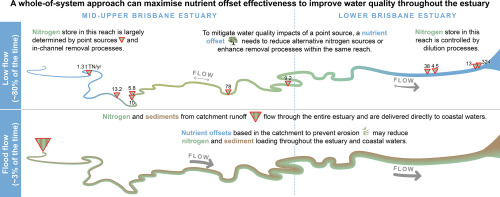
The Mid Brisbane Rivercare Program
The Brisbane River is much more than a familiar feature of South East Queensland’s landscape. Parts of the river and its tributaries form an important drinking-water catchment, which means the condition of surrounding farms, riverbanks, creeks, and vegetation can ultimately affect water quality downstream.
The Mid Brisbane Rivercare Program is designed around that connection. Rather than treating river health as an isolated environmental issue, the program works with landholders to improve the way properties and waterways are managed across the Mid Brisbane catchment.
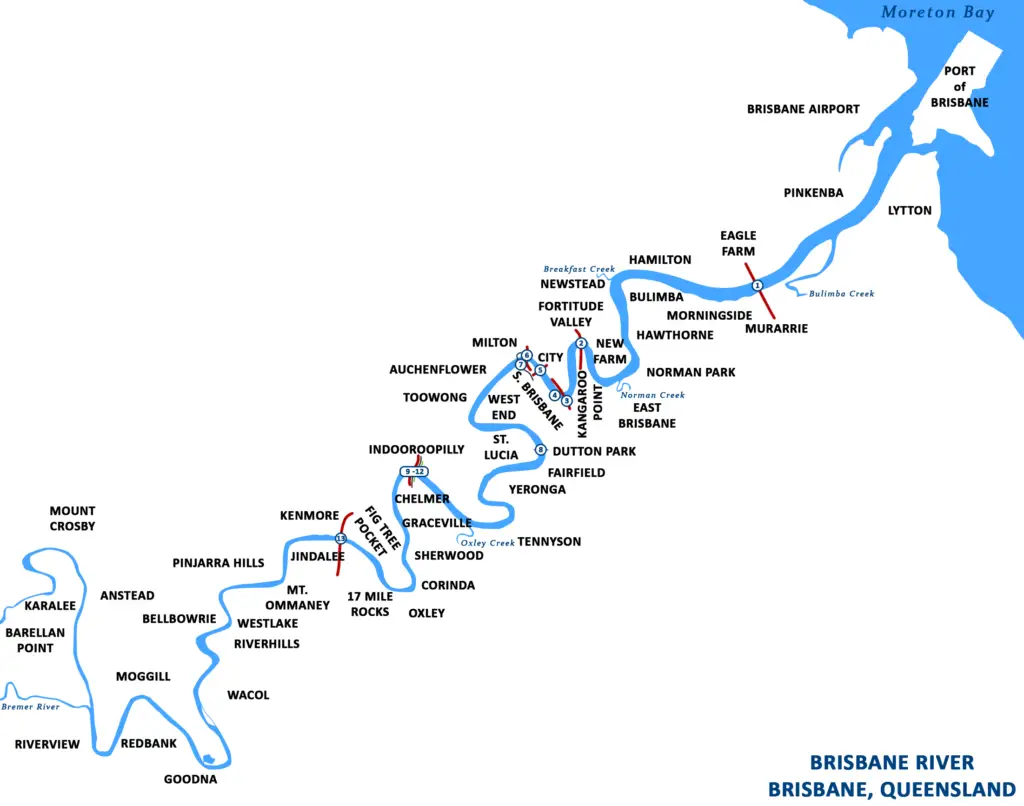
The program is associated with Healthy Land & Water, working in partnership with Seqwater and local landholders. Its central objective is straightforward: improve catchment health while helping landholders manage their properties more sustainably. The program particularly supports properties upstream of the Mount Crosby Water Treatment Plants, where protecting the catchment also contributes to protecting an important regional drinking-water supply.
What Is the Mid Brisbane Rivercare Program?
The Mid Brisbane Rivercare Program is a catchment-management initiative focused on improving land and waterway condition in the Mid Brisbane River area.
Healthy Land & Water describes the project as targeted investment in catchment health that can benefit both landholders and the Mid Brisbane water supply. It sits within the broader fields of catchment health and productivity, integrated catchment management, and water-resource management.
One of the program’s defining characteristics is that it does not separate farming from water management. Activities taking place on land near rivers and tributaries can influence erosion, sediment movement, vegetation, soil condition, and ultimately the quality of water entering the river system.
Instead of concentrating exclusively on repairing waterways after degradation occurs, Rivercare attempts to address some of these problems closer to their source.
Why the Mid Brisbane Catchment Matters
A catchment is the area of land from which rainfall and runoff eventually drain into a particular river, creek, reservoir, or other waterbody.
That means activities several kilometres away from a river can still influence it.
Heavy rain can move soil and other material from paddocks into smaller drainage lines. Those drainage lines feed creeks, which eventually connect with larger waterways. Riverbank erosion can similarly introduce substantial amounts of sediment directly into a river.
This is particularly important in a drinking-water catchment.
The Mid Brisbane Rivercare Program supports farmers upstream from the Mount Crosby Water Treatment Plants, making catchment management relevant not only to individual properties but also to the protection of regional drinking-water sources.
The Sediment Problem
Sediment is one of the major issues catchment restoration programs attempt to manage.
Some sediment movement is completely natural. Rivers continuously reshape their banks and channels. The problem arises when erosion becomes excessive.
Floods, loss of vegetation, livestock access, unstable riverbanks, degraded ground cover, and other disturbances can accelerate soil loss.
Once soil reaches waterways, it can contribute to increased turbidity and degraded aquatic habitat. From a water-supply perspective, preventing excessive soil from entering source water can be preferable to dealing with that material further downstream.
The practical philosophy is therefore simple:
keep soil on the land whenever possible.
This principle has been visible in Rivercare work following major flooding. Healthy Land & Water has highlighted riverbanks damaged during the 2022 floods where stabilisation and vegetation establishment were important for reducing further soil loss into the upper Brisbane River.
How the Program Works
The program uses a partnership model rather than approaching catchment restoration purely as a government infrastructure project.
The major participants include:
- Healthy Land & Water
- Seqwater
- local farmers and landholders
- other regional and local stakeholders where appropriate.
Seqwater funds and partners in delivery of the program, while Healthy Land & Water works with participating landholders on property and catchment-management activities.
This structure matters because much of the land influencing waterways is privately managed.
Catchment improvement therefore depends heavily on cooperation with the people who actually manage that land.
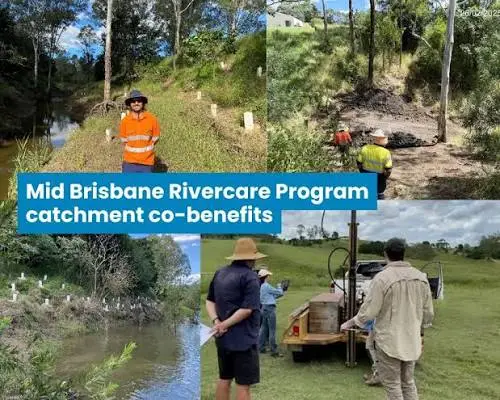
Healthy Land & Water
Property Planning and Assessment
An important part of Rivercare is understanding the individual property before deciding what intervention is appropriate.
There is rarely one solution that works everywhere.
One property may have an unstable riverbank. Another may have poor pasture condition. Somewhere else, livestock movement or inadequate vegetation may be contributing to erosion.
Assessments can therefore look at factors such as:
- soil condition;
- pasture performance;
- erosion risk;
- riverbank stability;
- vegetation;
- runoff pathways;
- livestock management;
- areas damaged by flooding.
For example, soil sampling has been carried out as part of the Mid Brisbane Rivercare Program to investigate why some pasture areas were performing better than others. That illustrates how the program combines environmental objectives with practical property management rather than treating the two as completely separate issues.
Riverbank Stabilisation
Riverbank erosion can be particularly damaging because soil is being lost immediately adjacent to the waterway.
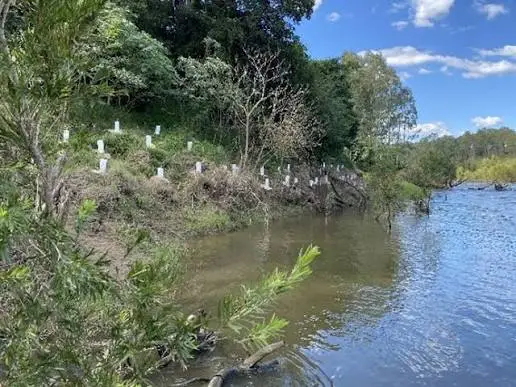
A healthy riverbank usually benefits from vegetation whose root systems help hold soil together. When vegetation disappears or a bank is severely damaged during flooding, it may become much more susceptible to further erosion.
Rivercare projects can therefore focus on restoring vulnerable sections of riverbank and establishing vegetation.
The goal is not simply to make a riverbank look greener. Successful stabilisation can help:
- hold soil in place;
- reduce continuing bank erosion;
- trap some sediment before it enters the river;
- restore riparian habitat;
- improve the long-term resilience of the river corridor.
This becomes especially valuable after floods, when already weakened banks may remain vulnerable to subsequent rainfall events.
Revegetation
Vegetation is one of the most useful natural tools available in catchment management.
Plants slow surface runoff, protect exposed soil and provide root systems that help stabilise the ground.
Along waterways, riparian vegetation can also create habitat and contribute to healthier river ecosystems.
However, revegetation is not simply a matter of planting as many trees as possible.
Effective projects need to consider local conditions, appropriate species, establishment success, erosion pressure, floods, weeds, livestock, and ongoing maintenance.
The real measure of success is whether vegetation becomes sufficiently established to perform its intended ecological and erosion-control function over the long term.
Soil and Pasture Health
One of the more interesting aspects of the Mid Brisbane Rivercare approach is its attention to agricultural productivity.
Healthy pasture provides ground cover.
Ground cover helps protect soil.
Protected soil is less vulnerable to erosion.
Less erosion generally means less sediment entering nearby waterways.
Consequently, improving pasture and soil management can potentially create benefits on both sides: the landholder may improve the condition or productivity of the property while the catchment receives better protection.
The soil-sampling work conducted through the program demonstrates this connection between farm management and water quality.
Working With Landholders
This may be the strongest element of the Rivercare model.
Environmental programs can struggle when they are designed independently of the people expected to implement or maintain the changes.
Rivercare instead treats landholders as partners.
That is important because farmers possess detailed practical knowledge of their properties: where water moves during storms, which banks regularly erode, where livestock congregate, which paddocks perform poorly, and which areas were damaged during floods.
Technical catchment expertise can then be combined with that local knowledge.
The result has the potential to produce interventions that are both environmentally useful and realistic to maintain.
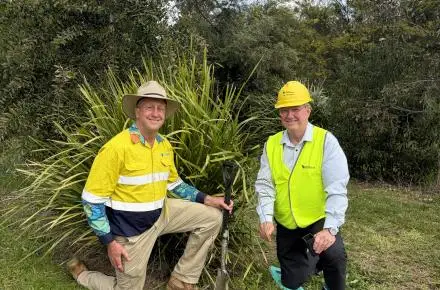
The Connection to Drinking Water
One of the biggest reasons this program deserves attention is its relationship with source-water protection.
Water treatment plants are capable of treating raw water, but treatment does not mean catchment condition becomes irrelevant.
A healthier source catchment provides another layer of protection.
Preventing excessive sediment and other pollutants from entering waterways is fundamentally different from removing them after they have entered the water supply system.
This concept is often referred to as source-water protection.
For the Mid Brisbane River, the relationship is especially direct because participating farmers are located upstream from the Mount Crosby Water Treatment Plants.
Flood Resilience
Floods are a natural part of river systems, but major floods can cause dramatic erosion.
Vegetation can be damaged or removed, banks can collapse, and large amounts of sediment can be mobilised.
The 2022 floods demonstrated this problem in the Brisbane catchment, with Rivercare-related work identifying vulnerable riverbanks requiring restoration to prevent continuing erosion.
Restoration cannot prevent major floods, of course.
Instead, the objective is resilience.
A well-vegetated, properly managed riverbank may be better able to withstand future disturbances than an exposed or already eroding bank. Likewise, healthy ground cover across surrounding land can reduce the vulnerability of soil during intense rainfall.
Environmental Benefits
The program potentially delivers several environmental benefits simultaneously.
Reducing erosion keeps more soil on farms and less sediment in waterways. Riparian restoration provides vegetation and habitat. Better ground cover can improve soil protection, while healthier river corridors can improve broader ecosystem condition.
This approach reflects a wider trend in Australian waterway management.
For example, the Australian Government’s Urban Rivers and Catchments Program similarly supports measures including riverbank restoration, revegetation, aquatic habitat improvement, water-quality improvement and stronger ecological connectivity.
The Mid Brisbane program applies many of the same underlying catchment-management principles in a landholder-focused context.
Benefits for Farmers
It would be easy to describe Rivercare exclusively as an environmental conservation program, but that misses an important part of its appeal.
Landholders can potentially benefit from:
Reduced erosion: Losing topsoil or riverbank land is a direct loss of a property’s natural resource base.
Improved pasture: Soil assessment and better management can help identify why particular areas are underperforming.
Better property resilience: Ground cover and stable waterways may reduce vulnerability to future rainfall and erosion.
Technical assistance: Catchment specialists can provide knowledge that individual landholders might otherwise need to source independently.
Shared investment: Partnership programs can make larger restoration works more achievable than expecting individual property owners to undertake everything alone.
This combination is why the program is appropriately described as a “win-win” for landholders and the Mid Brisbane water supply.
Benefits for the Wider Community
People living far away from participating farms can still benefit from catchment restoration.
The Brisbane River system is interconnected.
Actions upstream can influence conditions downstream, particularly where source water for drinking-water treatment is involved.
Potential community benefits therefore include healthier waterways, better-protected drinking-water catchments, improved landscapes and ecosystems, and greater resilience against erosion.
There may also be a financial logic to preventative investment. Catchment protection attempts to stop problems such as excessive sediment movement before they progress downstream, rather than relying entirely on later remediation or treatment.
How Quickly Does Rivercare Work?
Catchment restoration should not be judged like a construction project where completion immediately produces the final result.
Some benefits can occur relatively quickly. Stabilisation works can immediately protect vulnerable areas, for example.
Ecological recovery takes longer.
New vegetation needs time to establish roots and canopy cover. Soil condition changes gradually. Riverbanks experience repeated rainfall and flood events. Restoration sites may also require weed management and maintenance.
Consequently, the real value of a project may only become apparent over several seasons or after the site experiences another major weather event.
Challenges and Limitations
No catchment program can eliminate every threat to a river.
Extreme floods
Restored riverbanks remain exposed to powerful natural forces. Exceptional floods can damage even well-designed restoration projects.
Long establishment periods
Trees and other vegetation need time to mature, meaning some benefits are delayed.
Maintenance
Weeds, damaged fencing, failed plantings, erosion and livestock pressure can require continued management.
Participation
Because significant portions of catchments are privately owned, broad improvements depend on sufficient landholder participation.
Scale
Individual projects may be successful locally while the wider catchment continues to face erosion and other pressures elsewhere.
Monitoring
Catchment management also presents a measurement challenge. Separating the impact of one restoration project from rainfall variability, floods, land-use changes and other factors can be difficult.
Regional planning discussions have themselves identified monitoring and coordination as important gaps across catchment programs, reinforcing the need to measure whether on-ground investment is producing the intended results.
How Should Success Be Measured?
A strong evaluation should go beyond simply counting how many trees were planted or how many kilometres of riverbank received work.
More meaningful indicators could include:
- survival of planted vegetation;
- percentage of stable ground cover;
- changes in bank erosion;
- sediment reduction;
- water-quality trends;
- improved soil condition;
- pasture performance;
- resilience after subsequent floods;
- landholder participation;
- long-term maintenance of completed projects.
The distinction is important.
Outputs tell us what was done.
Outcomes tell us whether it actually improved the catchment.
Rivercare Versus Traditional River Repair
Traditional river restoration can sometimes concentrate heavily on the river channel itself.
Rivercare’s catchment perspective is broader.
Instead of asking only:
“How do we repair this damaged riverbank?”
the program can also ask:
“Why is this soil being lost in the first place?”
That can lead to interventions involving pasture, vegetation, soil, runoff, livestock management and property planning rather than simply engineering the riverbank.
This integrated approach is one of the program’s biggest strengths.
Review: What the Program Gets Right
The strongest feature of the Mid Brisbane Rivercare Program is its alignment of interests.
Healthy waterways matter to Seqwater.
Healthy land matters to farmers.
Reduced erosion matters to both.
That creates a practical foundation for cooperation.
The second major strength is prevention. Catchment protection attempts to address environmental problems upstream rather than relying solely on downstream treatment.
Third, the program acknowledges that environmental health and agricultural productivity do not always need to be competing objectives. Better soil management, pasture condition and erosion control can simultaneously benefit a farm and the river system.
Finally, its collaborative structure recognises the reality of catchment management: governments and environmental organisations cannot effectively manage privately owned landscapes without the participation of landholders.
Where the Program Needs Long-Term Commitment
The greatest weakness is not necessarily a flaw in Rivercare itself but a characteristic of restoration programs generally: results require time and continuity.
A planting project that receives funding for establishment but little subsequent maintenance may fail.
A stabilised riverbank can be damaged by another flood.
A successful project on one property cannot compensate for widespread degradation elsewhere in the catchment.
For that reason, the program’s long-term value depends on continued landholder engagement, appropriate maintenance, strategic selection of sites, monitoring, and investment over multiple years.
Regional authorities continue to support Mid Brisbane environmental investment. Somerset Regional Council documents from 2025, for example, refer to Resilient Rivers funding for investment in the Mid Brisbane River to improve environmental outcomes, with works reported as progressing.
Overall Verdict
The Mid Brisbane Rivercare Program is a strong example of integrated catchment management because it connects water security, environmental restoration and practical land management instead of treating them as separate problems.
Its greatest strength is the partnership between Healthy Land & Water, Seqwater and local landholders. The model gives farmers practical reasons to participate while simultaneously protecting a strategically important waterway and drinking-water catchment.
The program should not be viewed as a quick fix for the Brisbane River. Catchments are complex systems, and floods, erosion, land use and vegetation condition change continually.
Instead, Rivercare is best understood as long-term preventative infrastructure built partly with soil, vegetation, better land management and cooperation rather than concrete and machinery alone.
That distinction is important.
When erosion is prevented on a farm, the benefit does not necessarily stop at the property boundary. Less soil can enter the river, vulnerable banks can become more resilient, habitat can improve, and source water can receive additional protection.
For landholders, that can mean healthier and more resilient properties. For Seqwater, it supports protection of the water-supply catchment. And for the wider South East Queensland community, it represents investment in the health of a river system on which the region depends.
Overall rating: 4.5/5.
The concept is practical, collaborative and environmentally sound. Its ultimate success, however, depends on long-term participation, maintenance, monitoring and continued investment across enough of the catchment to turn successful individual projects into measurable river-scale improvements.
READ ALSO: What is rubbish?
